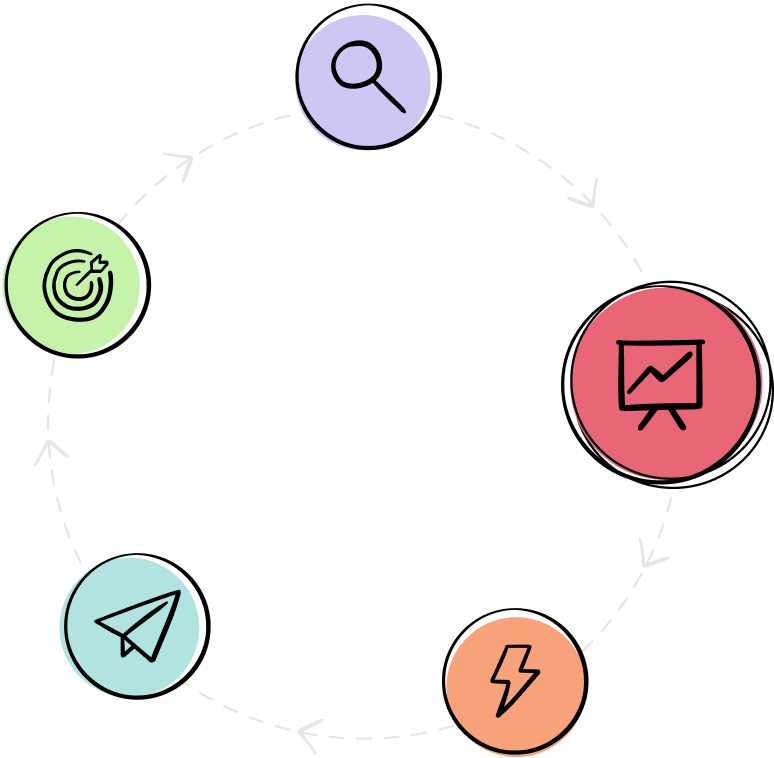
With EVIDENT, every design decision is mapped to some form of evidence; otherwise, it is not considered. Through deep research, data analysis, interviews, studies, and test results, we gather the evidence needed to ensure our designs not only look great but are proven to be usable and useful — before development starts.
STEP 1
Research
Our work begins with research. With the help of AI tools, we build a deep, evidence-based understanding of your business, industry, and users to drive smarter design decisions and deliver clear, self-evident user experiences.
Activities: Card sorts, Competitive analysis, Stakeholder & User interviews, Treejacks
STEP 2
Form Insights
Once we’ve gathered the evidence, we will leverage AI tools to efficiently and effectively organize and surface key insights about your business, competitors, and users to help drive all our design decisions.
Activities: Google analytics analysis, Heuristic analysis, Flow diagrams, User personas
STEP 3
Design
Guided by the evidence and key insights, we will start formulating ideas and designs. This includes everything from designing the information architecture and how users navigate to the design of individual screens and workflows. Our visual designs will also follow any existing brand guidelines to ensure the UX is aesthetically consistent with your brand’s look and feel.
Once we feel confident in our design direction, we will transform those designs into interactive, realistic previews of your product. This enables your team to see and experience the product before it is developed, and it allows us to conduct usability tests to validate or refine the designs.
To ensure our designs not only look great but are truly useful and self-evident, we conduct task-based usability testing with real users—identifying flaws and opportunities for refinement before any development begins.
Activities: A/B testing, Usability tests
How EVIDENT benefits your organization
Evident is designed to produce measurable outcomes — not just attractive interfaces. By combining evidence-based research, human-centered design, and AI-assisted insights, we help organizations reduce uncertainty, accelerate delivery, and create software experiences that users adopt quickly.
Decisions grounded in evidence
We rely on research, observation, and usability validation to drive all design decisions – not assumptions or opinions. This ensures product decisions align with how people actually work, not how teams think they work.
Lower development risk and rework
By validating workflows, interaction patterns, and usability before engineering begins, our methodology helps reduce costly refactoring cycles and minimizes the risk of building features users don’t need or understand.
Improved accessibility and usability at scale
Accessibility and inclusive design are built into the process from the start, helping organizations reduce compliance risk while creating experiences that work for a broader range of users.
Faster Time To First Value (TTFV)
Our approach prioritizes early user success, helping teams shorten the time it takes for users to experience meaningful value from a product. This leads to stronger adoption, higher productivity, and fewer usability barriers.
Developer-ready outcomes
Our process produces structured, implementation-ready deliverables; design systems, annotated prototypes, and front-end assets, that make development more efficient and reduce ambiguity during handoff.
Measurable impact on business outcomes
The result is not just better UX, it’s software that drives adoption, reduces support burden, and supports long-term product success.
Our EVIDENT AI Stack
Our use of AI tools and features is evolving on a regular basis, based on several factors including project needs, new AI tools and updates, and new AI features built into the tools we use. Below is just a small sampling of some of the tools and features we use, and what we use them for.
Research
Competitive UX analysis
Persona and journey synthesis
Research plan creation
Interview question generation
Pattern identification from qualitative data
Usability Testing & Usage Analytics
Recorded usability testing
Session recordings
Moderated and unmoderated testing
Task completion analysis
Predicts where users will look
Friction detection
Pattern identification
Auto transcriptions
Simulated eye-tracking
Sentiment analysis
AI summaries of findings
Design + Prototyping
UI inspiration
Coding + Testing
Content generation
Design system creation
Image and icon generation
Rapid concept visualization
Efficient file organization and labeling
Responsible use of AI
UX Team applies AI in a controlled, security-first manner to ensure client intellectual property and sensitive product information remain protected at all times. We use secure workflows, limit the exposure of proprietary data, and follow strict internal protocols that prevent confidential materials, source content, or unreleased product details from being shared with public AI systems. AI is used to accelerate research synthesis, pattern detection, and usability analysis—not to replace human judgment or access client-owned assets. This approach allows us to harness the speed and efficiency of AI while maintaining the confidentiality, ownership, and integrity of our clients’ IP and digital products.